Friday, March 24, 2017

Passion Projects 2017 - Reflection #1

This year, I have decided to introduce my grade 8 students to Passion Projects. I have been wanting to do this for a while, but I wasn't sure I was "ready". And then I realized that doing Passion Projects could be my own learning experience. It doesn't need to be perfect, or ready, or complete. I just have to dive in and get started. This is terrifying, but necessary!

Over the past month, I have spent time putting together a website for my students, reading blogs by other teachers, and gearing up to begin this endeavour. I chose to get going just after March Break, so that there would be a clear starting point.

One of the things that is most important to me in doing Passion Projects with my students is to really give them an opportunity to explore what they are passionate about. So often, students are told exactly what to do, exactly how to do it, and exactly what they should take away from the experience. In preparing students for the future, I think it is so important for them to learn to navigate new experiences, tap into their interests, and deal with obstacles on their own (with support as they deem necessary)

The idea of "failing" is so engrained in our students these days that, many times, they are afraid to even try. I hope that this project will allow them to see that they can try something, modify it, retry, re-modify and eventually get something out of the experience. I also hope that students will come away from this project feeling that their passions and interests are just as valid (if not more so) than what is taught in a traditional classroom.

So far, my students have been working on choosing the topic for their Passion Project. Some of them had ideas right away, while others are having a difficult time thinking of something they want to explore. I think that students are so often told what to do, they aren't sure if their ideas are valid. I'm hopeful that they will come to class next Friday (our official "Passion Project Work Period" each week) with an idea that they are passionate about. I want to avoid choosing ideas for my students, or steering them too much - this should be an opportunity for them to open themselves up to new learning experiences.

Along the way, I plan to complete a Passion Project with my students. I don't want to ask them to take on anything that I don't value myself. I have decided to learn Spanish as my primary Passion Project this year. I will also be blogging about the experience of integrating Passion Projects into my classroom, and updating/creating materials as I go - I'm calling this my "mini" Passion Project.

I have obtained a lot of resources from various sources, and plan to share what I create as well.
Notable sources include :

If you are/have been integrating this kind of learning experience into your teaching, I'd love to connect with you! Drop me a comment below!

Sunday, July 3, 2016

ISTE 2016 - A Denver Adventure!

I recently returned from my first ever "away" conference (i.e. out of province). I attended the International Society for Technology in Education (ISTE) conference in Denver. With close to 20 000 attendees, presenters & exhibitors, hundreds of sessions on all sorts of educational technology, and thousands upon thousands of people to meet...

All in all, it was quite overwhelming!

Despite the hugeness of it all, I managed to come away with a number of ideas that I'm keen to implement in my classroom, and to share with others through professional development and conversations.

One of the best parts about the conference was the opportunity to sit down and have conversations with other educators, and to try new ideas for myself. There were the playgrounds (tables set up around a theme, with the opportunity to explore various aspects), the poster sessions (over 35 booths set up to showcase excellence in educational practices), the sit and listen sessions, bring your own device sessions, and the campfires (getting together to chat in small groups about a given topic).

The campfire I attended on Gamification was an excellent opportunity to talk through some of the challenges of integrating game-like elements into the classroom in a small group, which meant we got to really share our ideas.
Also, we sat around an actual campfire ;-)

There was so much to see and do that I can't write about all of it here. Advice that I got from a veteran ISTE-goer was to pick just one or two things to focus on for the coming school year, and it's advice I intend to take! Small things, like the 5 Minutes of Creativity session I attended, will be easier to implement day to day - it's the larger, systemic changes that will take time and effort to do properly. My big goal is to really improve upon my Core French gamification plan for next year. I'll be looking at ClassCraft to help me out, and drawing on the conversations and resources from this past week.

If there is one huge takeaway from the conference, it is in something that Michelle Cordy, the closing keynote speaker said. She said, "Go home, and continue to be a connected educator. Ideas spread contagiously." As educators, we need to be ready to connect with each other, to share great ideas, and to be bold enough to try new things. I found her speech very inspiring, and from the reactions of the crowd, I'm sure others felt the same way.
Here we are doing power poses during the closing keynote

If you ever have an opportunity to attend a large-scale conference as an educator, I would highly recommend it. Not just for the content of the sessions, but for the amazing connections you can make with other people who are just as passionate about teaching as you are! I will definitely be reaching out in the future to the people I met, and I look forward to ongoing collaboration.

Thursday, June 23, 2016

Rube Goldberg Machines - Take 2

It's time once again for Rube Goldberg Machines! Last year, I posted about my class' experience leading up to and during this activity. This year, I only gave students one day of lead time (we were working on a large project up until two days before this activity, and I didn't want to distract from that). They were excited and curious, and spent approximately 20 minutes making lists of things that could help them solve an unknown design challenge. I also gave them the opportunity to request items from me, but only if they got their requests in ahead of knowing what the challenge entailed.

To start the day of the challenge off, I showed my students the OK Go video, This Too Shall Pass. If you've never seen it, I highly recommend taking 4 minutes right now to do so. I'll wait...

...

...

...

...

Amazing, right? This was the visual prompt I used to set my students up to create very interesting constructions. They had brought in a wide variety of items once again. Along with the basic items I provided to them (paper, tape, a tack, a marble, paper clips, clothespins, yarn, straws, a paper plate and a balloon) groups had brought in :


  • duct tape
  • nail scissors
  • glue guns
  • a canvas lawn chair
  • empty water bottles
  • a plastic bucket
  • a pillow
  • giant sponges
  • locker mirrors
  • skipping rope
  • tin foil
As they began to work with their groups, I circulated around the classroom, listening in on conversations. I consider it a mark of enormous success that students did not ask me what they should try, but instead jumped straight into collaborating with their group members to make a plan.

Taking stock

Beginning to plan

Group 1 : Materials

Group 2 : Materials

Group 3 : Materials
As students planned, I listened. Here are some of the comments I overheard :

"Let's start by putting all the things that could pop the balloon in a pile."

"Ok, now try that way. Make a little dent in it."

"If we put the ball here instead of there, the ruler would have enough energy to move the sponge."

"We should put the tack on a string, and then it could swing and pop the balloon."

"We should start at the end of our machine - how will be pop it?"

"I'm not really sure if this is going to work, but it's a start."

"It can't go slow, or else it won't move the potato masher!"


Although none of the groups managed to pop their balloon, they had a lot of fun trying. At the end of the period, after they had all tried their machines, I took a moment to read them the list of comments I had overheard, and to underline the importance of perseverance. All of the groups had ideas for how they could have improved on their design, even though they knew they were not going to have a second chance.

The amount of learning that went on in those two hours that they were working collaboratively to solve a problem was phenomenal! It gave me a renewed sense of just how important it is to give students the freedom to try, fail, and try again. 

Wednesday, March 2, 2016

Dr Seuss as Inspiration

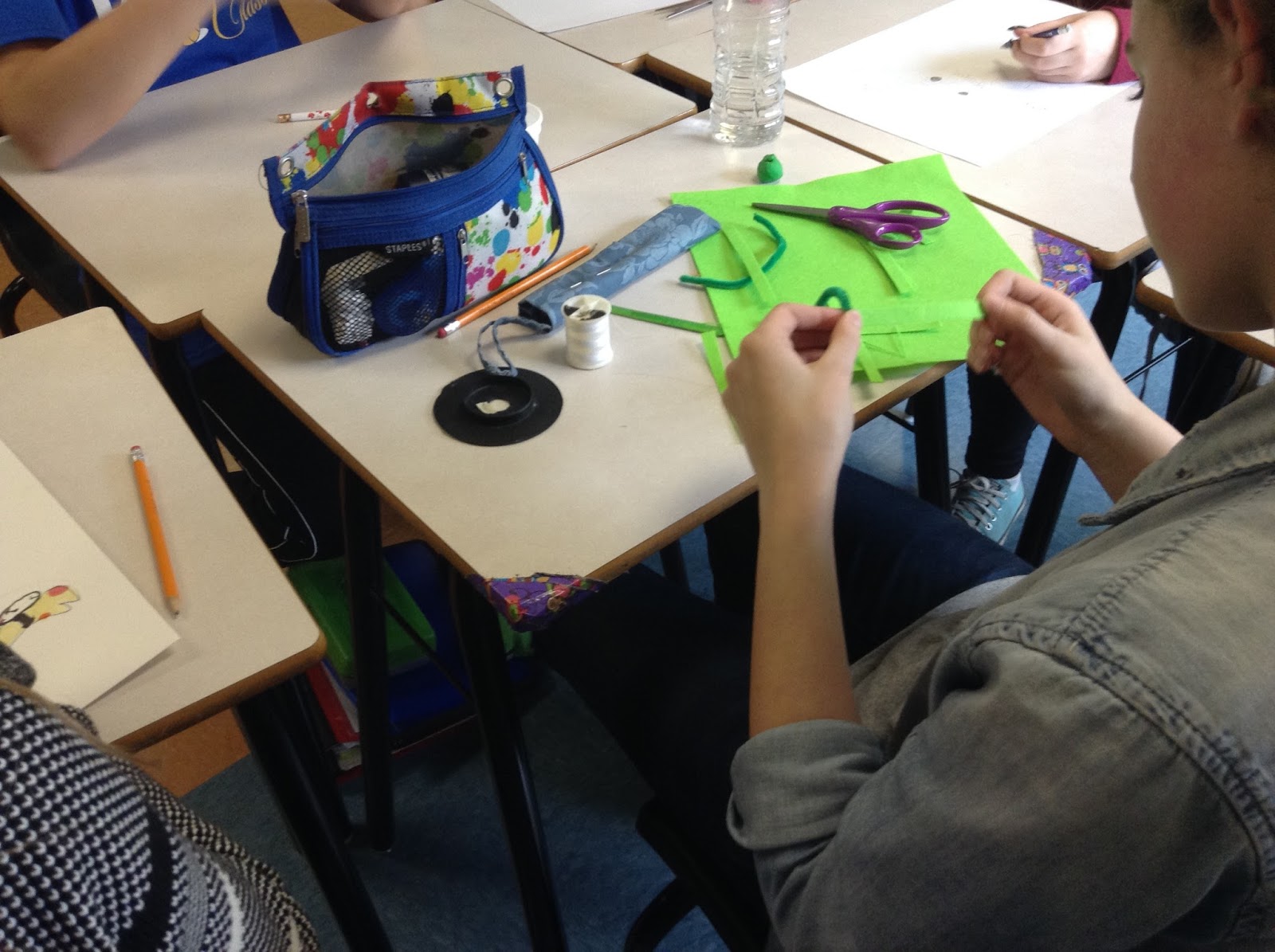
Appropriately, today is "Dr Seuss Day". My grade 7 English Language Arts class has been working on an author study based on Dr Seuss for the past few weeks. The final aspect of this unit is to create their own "Seussville" character, and to write about their character using Dr Seuss-style writing. This week, students were engaged in what I like to call Organized Chaos while they brought their characters to life.

It's not always easy to achieve Organized Chaos in a classroom. It takes a lot of discussion and negotiation to get students to the point where they can be working independently, on-task, taking risks, helping each other, making messes (and cleaning them up!) and just generally being creative without a whole lot of intervention on my part. We've been working towards this point since the beginning of the year, but with only 30 minutes per day it takes time to get students on board with my particular brand of Organized Chaos and have them be successful. For the past two Wednesdays, we have had 60 minutes of class time together, and we have unlocked this achievement - and I couldn't be happier! This particular group of students will be in my homeroom next year, which translates into roughly 3 hours with me per day. It makes me look forward to next year, knowing that they are already skillful "Mme Gaudet Interpreters" ;-)

Here are some of their Seussville characters in progress. You'll notice that they are using a wide variety of supplies to achieve their desired goal. Lots of problem solving is going on in my classroom these days...


Wednesday, January 27, 2016

When PowerPoints are banned

This past week, my students have been learning about specific groups of immigrants who have come to Canada for various reasons over the past 100 years. I set the reading up as a jigsaw activity, giving each student in a group of four a different article to read. After they had read their articles, they got together with the people from the other groups who had read the same article, and discussed what they had learned.

Then the fun began.

I asked each group to come up with a way of communicating their pooled information to the rest of the class, to the people who had not read about that particular group of immigrants. The catch? They were not allowed to create anything resembling a PowerPoint presentation (no Google Slides, no NearPod, no slideshow of any kind) As they started discussing what they would do instead, I heard one group laughing at their shared idea of doing an obstacle course - they were dismissing the idea out of hand.

I casually mentioned to the class at large that any idea would be worth exploring, and that they shouldn't hesitate to think outside of the box for this activity. The group discussing the obstacle course positively beamed when they realize their idea didn't have to just be a joke!

Here's what they set up to teach the rest of the class about Vietnamien refugees between 1975 and 1995.

Getting ready for the rest of the class to arrive

Setting up

Students had to relay race on mats to represent the boats that Vietnamien refugees would have travelled on to get to Canada.

Building a house with substandard materials to represent camps that refugees often stay in.

Vietnamien refugees were ill-prepared for the winters in Canada, and had to wear whatever they were given.

The beanbag toss represented the fact that it was easier for younger refugees to find work (the students in each group lined up from youngest to oldest, with the youngest students closer to the hoops)

Putting all the pieces of the puzzle together. Each group had a different puzzle to make, to underline the fact that many elements go into determining whether or not an immigrant will be successful in Canada (languages spoken, former education, age and luck were all pieces of the puzzle discussed by the group who created the presentation)

I love it when I give my students the freedom to think and create outside of what they normally view as "school" activities. This group in particular was very thoughtful in their creation of an activity that would simulate in some small part the challenges that immigrants and refugees face. PowerPoints have their place, but so does creative thought. And, in my opinion, even more so.

Saturday, December 12, 2015

Recreating a Painting in Minecraft

I've been dabbling with Minecraft for the better part of a year (or, more accurately, with MinecraftEDU, the educational mod that is available thanks to the wonderful people at TeacherGaming) Through our Exploratory program, I've experimented with a wide range of worlds, mainly with students who have prior experience with, and lots of passion for, Minecraft. My main goal, however, has always been to integrate Minecraft into my teaching practice.

This week, for the first time, I had an opportunity to do just that, in the context of grade 8 Visual Arts. The other teachers who teach Visual Arts with me were incredibly open-minded, and let me take the reins (and I think they were as pleased with the results as I was!)

I created a questionnaire for students, asking them to choose a painting that they would recreate in Minecraft, with a group. Their choices were:

Starry Night - van Gogh
The Starry Night - Vincent van Gogh

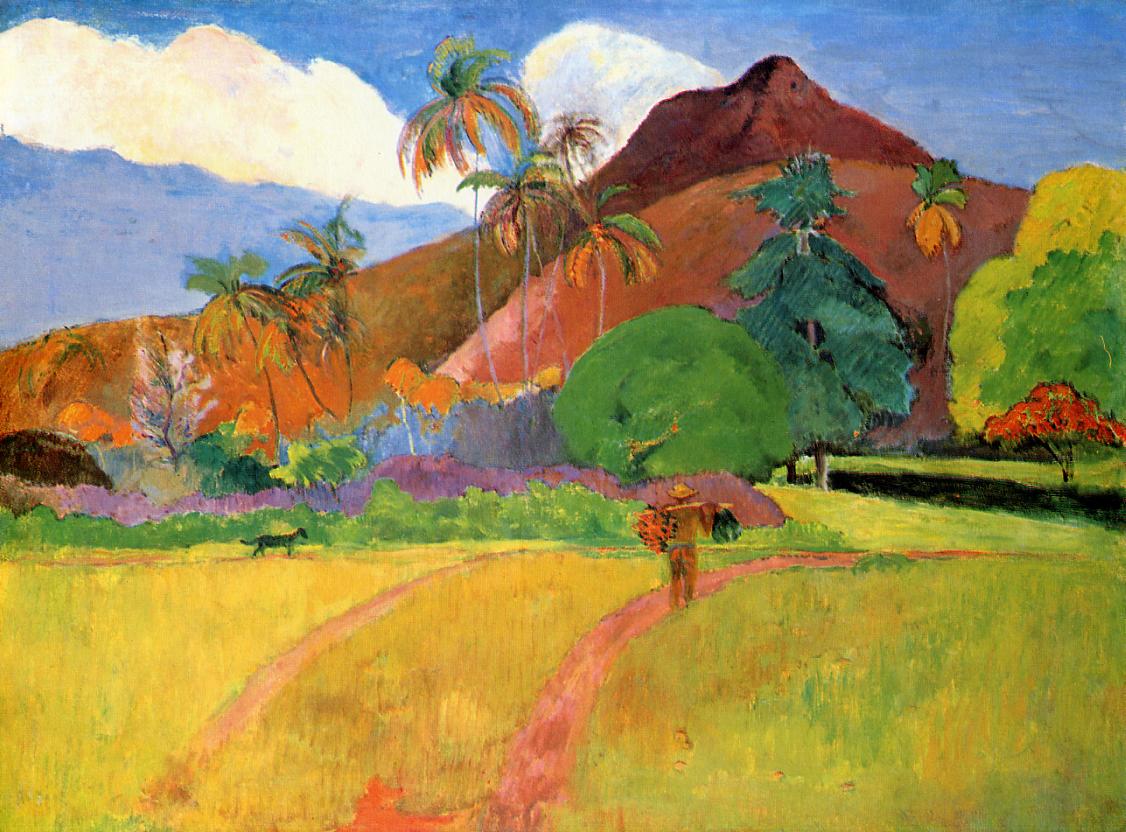
Tahitian Landscape - Gauguin


Three Cats - Maud Lewis


The Scream - Munch


The Great Wave off Kanagawa - Hokusai


Composition #2 (1920) - Mondrian


Three Musicians - Picasso


Tulip Field with the Rijnsburg Windmill - Monet


After students had made their selections, I assigned them to work in groups of four or five. Surprisingly, only one or two students had chosen the Monet, and none were interested in the Picasso, so those two were not recreated.

Upon entering the Minecraft environment, students found themselves in a room with 8 doors, each labeled with the title of the painting as well as the students' names.


They walked through the door, and teleported to an empty field with these instructions:


And then they got to work. Sitting next to their group members, they decided what format their recreation would take, and then dividing tasks to be as efficient as possible in their building. Several students who generally let others take the lead really stepped into a leadership role at that point, as they have lots of experience in Minecraft. There were two students who had never played Minecraft before, and their group members were patient in explaining how to move around and place blocks.

Here are the results of two days of building (approximately 90 minutes in total) :

Starry Night (work in progress)
Look at all the detail they have included! The tiny houses! The swirls in the sky!

Tahitian Landscape (work in progress)
My newest Minecrafter created that mountain from scratch. I am also quite impressed with their choice to combine a 3D idea with a top down view.

Three Cats (complete)
This group took on the challenge of finding a way to make their cats look fuzzy :-) 

The Scream (complete)
All the detail! The bridge! The sky!

Great Wave off Kanagawa (complete)
These students struggled a bit with their idea and their ability to work as a cooperative group. They became frustrated and destroyed what they had begun two times. As a result, they didn't have a lot of time to create their painting, and it is significantly smaller than the others. However, their use of real flowing water, and the fact that they placed NPCs (non-player characters) in their boats and named them after themselves more than makes up for the size! And in the end, they were very happy with their effort.

Composition #2 (complete)
This one was the simplest, but I was impressed by the amount of thought and planning that went into getting the proportions correct! 

All in all, I consider this first educational application of Minecraft to be an enormous success. Students were engaged, creative, cooperative problem solvers.

On Tuesday, all students will go on a gallery walk through the paintings of other groups. I can't wait for them to appreciate the work that each group put into their recreation, and to show off their own piece of art!

Take a Video Tour!


Tuesday, October 13, 2015

Gaming to Communicate

I like playing board games. And card games. And guessing games. And logic games.

I like games.

I try to use games in my teaching as often as possible. Not the "made for the classroom" games that seem to take much of the fun out of playing a great game, but games like 99 (a great card game that also reinforces Math skills), Word on the Street (spelling! tug-of-war!) or Morphology Jr (an excellent combination of building, charades and guessing). I also really value the days during the year when I have time to play other, less obviously academic, games with my students. Ghost Blitz and Squashed were crowd favourites last year.

This year, I've decided to try something new to build a strong classroom community. I am hosting once-a-month Games Nights for students and their parents. The guidelines are simple : students must come with at least one parent or guardian, parents or guardians must come with at least one student. No cost. No commitment. No RSVP. Whoever shows up can play whatever games they want.

Tonight was the first night. Only one of my students attended, with her mother. Their game request? They both wanted to learn how to play Settlers of Catan. We spent a highly enjoyable time playing together, and I feel as though I know a lot more about that particular student from watching her interact with her mother, and from observing how she plays games.

I am very much looking forward to future Games Nights - sometimes there will be only two guests, other times there may be many more. Either way, I think this is going to be a great opportunity to create connections with parents whose only contact with the school up to this point may have been phone calls or emails about missing homework assignments or discipline problems. If I can get parents to have fun with me, those more difficult conversations may become ever so slightly easier.

And, of course, I'm just always looking for someone to play games with me ;-)

Photo credit: http://www.ubcieee.org/events/boardgames2015