Tuesday, February 13, 2018

Literary Projects

Students in my 8th grade French Immersion class know that they are expected to be reading at all times, in French, at a level that is appropriate to them. We call this their "toujours devoirs" (always homework). They do not fill out reading logs, they do not write book reports, they do not have to read a certain amount per day, per week, or per month.

However, every five or six weeks, they are given approximately 5 hours of class time (over five days) to create a project based on one of the books they have recently read. There are only two main requirements that I provide to students for these projects : their project must in some way encourage others to read the book, and they cannot choose the same project they have previously completed (e.g. if they have done a painting as a literary project already this year, they cannot do another painting) The learning curve on what constitutes five hours of quality work is generally steep, but I find that my students appreciate the fact that I allow them to budget their own time and encourage them to do their best possible work. Most of the time, students impress me (and each other!) with their projects.

This is our third literary project of the school year, which means that students have already done two projects. I find that the third and fourth projects are generally ones where students are thinking outside of the box. Earlier in the year, they tend to choose the project types with which they are the most comfortable. By February, they have grown accustomed to my requests that they think creatively, try new things, take risks, and persevere.

Here are some things that my students are creating for their literary project today :

Two paintings, one representing the personalities of the characters in the book, the other showing an important object from a different book. 

At the top : a menu for a theme restaurant inspired by Le Petit Prince
On the bottom : a crayon drawing


The beginnings of a board game
A watercolour background is shaping up for this student's project

This student is creating a riddle-based scavenger hunt for the class to complete.

Another board game is shaping up nicely. This student required some encouragement to create something a little more "professional" looking - sometimes grade 8 students suffer from "good-enough-itis" ;-)

A website in progress

Friday, May 5, 2017

Passion Projects 2017 - Reflection #3


We are now on week 6 of Passion Projects in my class, and I wanted to take this opportunity to write about the experience of students who are have some struggles with the freedom this project affords them.

Our routine is to work on Passion Projects each Friday (if there is no school on a Friday, we work on Thursday instead) This regularity of scheduling allows students to plan for what they need to bring into school, work on things at home over the course of the week and report in their journals on Fridays, and predict when they will need to have tasks accomplished.

On Thursdays, I ask students to fill out a brief check-in page in order to let me know how things have been progressing with their projects, and to remind them that they need to bring all required materials the next day. As part of that check-in page, I ask students to mark on a line how they are feeling about their project - the responses can range from "Awesome" to "Meh" to "HELP!"

Weekly Check-In Page


This check-in page has been a great help in identifying students that are treading water rather than making significant progress. I go through them and schedule conferences with any students who are hovering in the "Meh" range (or who have indicated that they need HELP! - although nobody has felt that desperate yet...)

The "no unfortunately" was a red flag for sure!


This student changed ideas after the first week, and hasn't
seemed all that passionate about his new idea


This student turned things around without much prompting from me


At this point in the project, some students are recognizing that they have chosen tasks that they are not feeling passionate about any more. What seemed like a good idea at the time (using a new crocheting set, for example) has lost some of its lustre. The check-in page gives me a heads-up that someone needs to have a quick conversation and might need a nudge to get going in a different direction if they have lost their passion for their initial idea.

Out of 25 students, only 2 have found themselves in this situation so far (the third person was just feeling a bit overwhelmed and was able to get back on track with little difficulty). The vast majority of my students are engaged and excited on Passion Project work days, and work independently for the entire hour. The two exceptions are students who might have needed to reflect a little more on what really makes them excited before settling on their project idea.

I am still learning Spanish as my Passion Project alongside my students. If you want to take a peek, here are the links :

Week 1 - Why I Want to Learn Spanish
Week 2 - Progress So Far
Week 3 - Plateau

Feel free to leave a comment below if you have any questions (or if you are also doing Passion Projects with a group of students!)

Saturday, April 8, 2017

Passion Projects 2017 - Reflection #2

This week's major assignment in the world of Passion Projects was creating a 60-Second Pitch. Students presented their pitches to the class, and their peers had an opportunity to ask them questions and to assess whether or not they think that each individual is on the right track to begin their Passion Project.

In order for a student to get the "green light" for their project, at least 75% of the class has to give them their approval. I used ZipGrade and bubble sheets that were numbered 1-25 (each student was assigned a number in alphabetical order) At the end of each 60-second pitch, students either coloured in the Yes bubble or the No bubble for the corresponding number, depending on whether or not they thought the project was thought through enough. This app made it very easy to determine how many people had voted to approve each project - doing it all by hand would have been painful!

I chose to "yellow light" student #2 as I also had
some questions about his project. A short conference later
and his idea was clearer and ready for the green light.


This worked really well, and most students were given the green light by their peers. A couple of students got the yellow light (between 50% and 75% of peers voted to approve their project), and nobody received a red light (which would have been less than half of the class voting to approve) I was worried that students would simply green-light everyone, but that turned out not to be the case. I was able to have short conferences with those students who received the yellow light, and helped them to clarify their ideas a little more.

So far, I have seen huge amounts of motivation during this project. Students are conducting independent research, helping each other by asking good questions, arranging conferences with me as needed, spending time on the project outside of school time... All in all, a very successful start.

I do anticipate that some students will eventually hit a wall in their project, and I am hopeful that it will be a learning opportunity for them. If they can learn how to deal with failure, how to persevere, how to be flexible in thinking and planning then I will consider the project to be a success overall.

I am doing a Passion Project alongside my students. You can find my Learning Spanish blog below :

Week 1 - Why I Want to Learn Spanish
Week 2 - Progress So Far
Week 3 - Plateau


Friday, March 24, 2017

Passion Projects 2017 - Reflection #1

This year, I have decided to introduce my grade 8 students to Passion Projects. I have been wanting to do this for a while, but I wasn't sure I was "ready". And then I realized that doing Passion Projects could be my own learning experience. It doesn't need to be perfect, or ready, or complete. I just have to dive in and get started. This is terrifying, but necessary!

Over the past month, I have spent time putting together a website for my students, reading blogs by other teachers, and gearing up to begin this endeavour. I chose to get going just after March Break, so that there would be a clear starting point.

One of the things that is most important to me in doing Passion Projects with my students is to really give them an opportunity to explore what they are passionate about. So often, students are told exactly what to do, exactly how to do it, and exactly what they should take away from the experience. In preparing students for the future, I think it is so important for them to learn to navigate new experiences, tap into their interests, and deal with obstacles on their own (with support as they deem necessary)

The idea of "failing" is so engrained in our students these days that, many times, they are afraid to even try. I hope that this project will allow them to see that they can try something, modify it, retry, re-modify and eventually get something out of the experience. I also hope that students will come away from this project feeling that their passions and interests are just as valid (if not more so) than what is taught in a traditional classroom.

So far, my students have been working on choosing the topic for their Passion Project. Some of them had ideas right away, while others are having a difficult time thinking of something they want to explore. I think that students are so often told what to do, they aren't sure if their ideas are valid. I'm hopeful that they will come to class next Friday (our official "Passion Project Work Period" each week) with an idea that they are passionate about. I want to avoid choosing ideas for my students, or steering them too much - this should be an opportunity for them to open themselves up to new learning experiences.

Along the way, I plan to complete a Passion Project with my students. I don't want to ask them to take on anything that I don't value myself. I have decided to learn Spanish as my primary Passion Project this year. I will also be blogging about the experience of integrating Passion Projects into my classroom, and updating/creating materials as I go - I'm calling this my "mini" Passion Project.

I have obtained a lot of resources from various sources, and plan to share what I create as well.
Notable sources include :

If you are/have been integrating this kind of learning experience into your teaching, I'd love to connect with you! Drop me a comment below!

Sunday, July 3, 2016

ISTE 2016 - A Denver Adventure!

I recently returned from my first ever "away" conference (i.e. out of province). I attended the International Society for Technology in Education (ISTE) conference in Denver. With close to 20 000 attendees, presenters & exhibitors, hundreds of sessions on all sorts of educational technology, and thousands upon thousands of people to meet...

All in all, it was quite overwhelming!

Despite the hugeness of it all, I managed to come away with a number of ideas that I'm keen to implement in my classroom, and to share with others through professional development and conversations.

One of the best parts about the conference was the opportunity to sit down and have conversations with other educators, and to try new ideas for myself. There were the playgrounds (tables set up around a theme, with the opportunity to explore various aspects), the poster sessions (over 35 booths set up to showcase excellence in educational practices), the sit and listen sessions, bring your own device sessions, and the campfires (getting together to chat in small groups about a given topic).

The campfire I attended on Gamification was an excellent opportunity to talk through some of the challenges of integrating game-like elements into the classroom in a small group, which meant we got to really share our ideas.
Also, we sat around an actual campfire ;-)

There was so much to see and do that I can't write about all of it here. Advice that I got from a veteran ISTE-goer was to pick just one or two things to focus on for the coming school year, and it's advice I intend to take! Small things, like the 5 Minutes of Creativity session I attended, will be easier to implement day to day - it's the larger, systemic changes that will take time and effort to do properly. My big goal is to really improve upon my Core French gamification plan for next year. I'll be looking at ClassCraft to help me out, and drawing on the conversations and resources from this past week.

If there is one huge takeaway from the conference, it is in something that Michelle Cordy, the closing keynote speaker said. She said, "Go home, and continue to be a connected educator. Ideas spread contagiously." As educators, we need to be ready to connect with each other, to share great ideas, and to be bold enough to try new things. I found her speech very inspiring, and from the reactions of the crowd, I'm sure others felt the same way.
Here we are doing power poses during the closing keynote

If you ever have an opportunity to attend a large-scale conference as an educator, I would highly recommend it. Not just for the content of the sessions, but for the amazing connections you can make with other people who are just as passionate about teaching as you are! I will definitely be reaching out in the future to the people I met, and I look forward to ongoing collaboration.

Thursday, June 23, 2016

Rube Goldberg Machines - Take 2

It's time once again for Rube Goldberg Machines! Last year, I posted about my class' experience leading up to and during this activity. This year, I only gave students one day of lead time (we were working on a large project up until two days before this activity, and I didn't want to distract from that). They were excited and curious, and spent approximately 20 minutes making lists of things that could help them solve an unknown design challenge. I also gave them the opportunity to request items from me, but only if they got their requests in ahead of knowing what the challenge entailed.

To start the day of the challenge off, I showed my students the OK Go video, This Too Shall Pass. If you've never seen it, I highly recommend taking 4 minutes right now to do so. I'll wait...

...

...

...

...

Amazing, right? This was the visual prompt I used to set my students up to create very interesting constructions. They had brought in a wide variety of items once again. Along with the basic items I provided to them (paper, tape, a tack, a marble, paper clips, clothespins, yarn, straws, a paper plate and a balloon) groups had brought in :


  • duct tape
  • nail scissors
  • glue guns
  • a canvas lawn chair
  • empty water bottles
  • a plastic bucket
  • a pillow
  • giant sponges
  • locker mirrors
  • skipping rope
  • tin foil
As they began to work with their groups, I circulated around the classroom, listening in on conversations. I consider it a mark of enormous success that students did not ask me what they should try, but instead jumped straight into collaborating with their group members to make a plan.

Taking stock

Beginning to plan

Group 1 : Materials

Group 2 : Materials

Group 3 : Materials
As students planned, I listened. Here are some of the comments I overheard :

"Let's start by putting all the things that could pop the balloon in a pile."

"Ok, now try that way. Make a little dent in it."

"If we put the ball here instead of there, the ruler would have enough energy to move the sponge."

"We should put the tack on a string, and then it could swing and pop the balloon."

"We should start at the end of our machine - how will be pop it?"

"I'm not really sure if this is going to work, but it's a start."

"It can't go slow, or else it won't move the potato masher!"


Although none of the groups managed to pop their balloon, they had a lot of fun trying. At the end of the period, after they had all tried their machines, I took a moment to read them the list of comments I had overheard, and to underline the importance of perseverance. All of the groups had ideas for how they could have improved on their design, even though they knew they were not going to have a second chance.

The amount of learning that went on in those two hours that they were working collaboratively to solve a problem was phenomenal! It gave me a renewed sense of just how important it is to give students the freedom to try, fail, and try again. 

Wednesday, March 2, 2016

Dr Seuss as Inspiration

Appropriately, today is "Dr Seuss Day". My grade 7 English Language Arts class has been working on an author study based on Dr Seuss for the past few weeks. The final aspect of this unit is to create their own "Seussville" character, and to write about their character using Dr Seuss-style writing. This week, students were engaged in what I like to call Organized Chaos while they brought their characters to life.

It's not always easy to achieve Organized Chaos in a classroom. It takes a lot of discussion and negotiation to get students to the point where they can be working independently, on-task, taking risks, helping each other, making messes (and cleaning them up!) and just generally being creative without a whole lot of intervention on my part. We've been working towards this point since the beginning of the year, but with only 30 minutes per day it takes time to get students on board with my particular brand of Organized Chaos and have them be successful. For the past two Wednesdays, we have had 60 minutes of class time together, and we have unlocked this achievement - and I couldn't be happier! This particular group of students will be in my homeroom next year, which translates into roughly 3 hours with me per day. It makes me look forward to next year, knowing that they are already skillful "Mme Gaudet Interpreters" ;-)

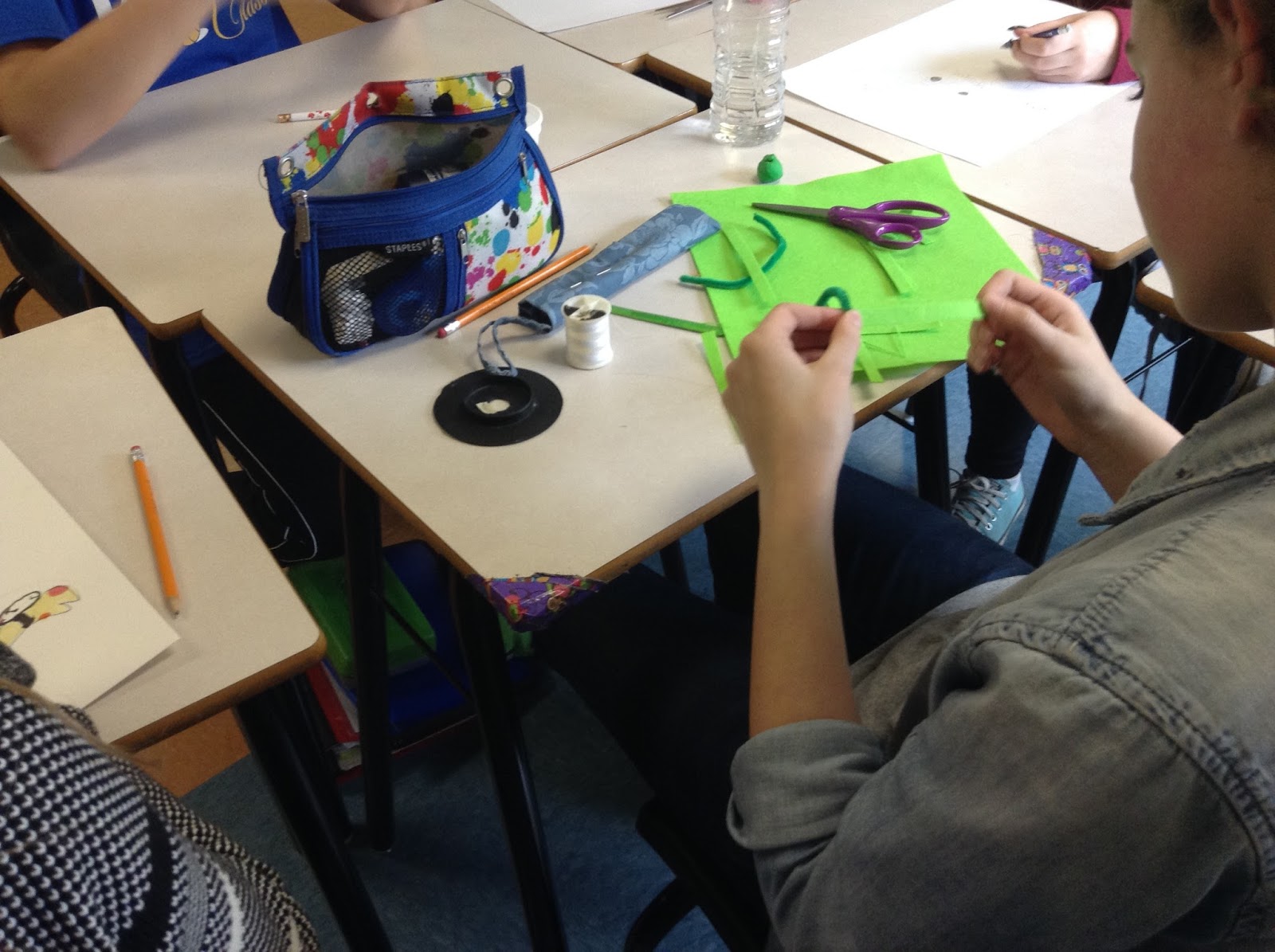
Here are some of their Seussville characters in progress. You'll notice that they are using a wide variety of supplies to achieve their desired goal. Lots of problem solving is going on in my classroom these days...