Showing posts with label organized chaos. Show all posts

Tuesday, August 18, 2020

Returning to Physical Classrooms - Some Thoughts

 I wrote a long thread on Twitter today, about my thoughts as we prepare to in-person classrooms three weeks from today. Here is the text of that thread : 

ImageImage

Context : I am a public school teacher in Nova Scotia, Canada. We have 4 active cases of Covid-19 in the province. We are requiring a 14-day self-isolation period for all travellers coming from outside the Atlantic provinces. Masks are required in all indoor public spaces for people 2 years of age and up (grocery stores, restaurants, hair salons, etc.) Masks will be required in the classroom for grades 4 and up where students are not able to be 2m apart (read: the majority of classrooms)

Compliance with the above measures are part of the reason we have so few cases in the province. We did the work to limit opportunities for the virus to spread. We will continue to do what we can to limit the spread when we return to our physical buildings with students in 3 weeks.


There are many valid concerns about class sizes not allowing for physical distancing in classrooms, about where students and staff will eat lunch, about how we will navigate frequent hand washing/sanitizing of surfaces, and about the state of our ventilation systems. 


Teachers, myself included, have indicated that we need more time to prepare to welcome students back into physical classrooms in September. The physical reasons listed above are part of that - we need time as school staff to discuss what those things will look like for our specific sites. In addition, we need time to debrief the past 6 months, in the context of a global pandemic, the science-denial happening in parts of the world, systemic racism, and the fact that we will have staff and students alike who view school as an unsafe place right now.


We need time to reconnect with our colleagues in an authentic, compassionate way. This isn't something that can be done in two days while we are doing all of the other things that need to happen before students walk through the doors of our classrooms. How are we? What do we need? Who is struggling? Who is in a space to provide support to others? What does it feel like to be in physical proximity to so many people outside of our own families again? These questions are so important to discuss/consider before we interact with students.


Having time to collectively consider/discuss those questions is essential. Lori Desautels says we need to secure our own oxygen mask first. There will be a lot coming up for the adults in the building that needs to be addressed before we are ready to help students.


We also need time to plan how we will run our classes with the restrictions in place. My classroom involves small-group collaboration, sharing of art materials, circle discussions, one-on-one conferences, whole-class discussions, and lots of opportunities for movement. I use a wide variety of strategies to practice "brain intervals" or "brain breaks", many of which are self-directed and involve the use of physical objects such as puzzles, games, fidgets, and brain teasers. I need time to rethink these strategies in ways that are safe. My classroom environment is what I call “organized chaos” - students make choices about where to work, and have open access to technology and supplies. I begin the year with a collaborative design challenge inspired by John Spencer. I need time to plan how to do this in a new context. 


Sitting in rows all facing forward doesn't lend itself to the best practices I have developed over my 16 years as a middle school teacher. I need time to collaborate with other teachers in order to find ways of delivering the best possible educational experience for students. We need time, not just to understand new procedures and health guidelines, but to come together and plan a way forward in a very different environment. 


Alex Shevrin Venet says students and staff are likely to be hyper-vigilant when we return to in-person classrooms. Every sniffle and cough may be scrutinized, every improperly worn mask may be pointed out. Staff need time to develop strategies to help mitigate this hyper-vigilance.


I am excited to return to my classroom in person, and I need time to get ready. What could staff do better if we were given the first week to prepare in a meaningful way, before students enter our classrooms?

Thursday, September 26, 2019

The Definition of 'Success'

Image result for success


Today's French class was brought to you by the letters A - E - G and A. My grade 8s participated in a digital escape room organized by Cavilam. Our mission was to save the French language from disappearing, and there were a series of puzzles and challenges to complete in order to do so.  In my class, I registered five teams with five students on each team. The official instructions indicated that a minimum language level of B1 on the DELF was necessary to participate. My students have not written the DELF, but I would put their competence somewhere around A2 (the progression is A1, A2, B1, B2, C1, C2)  I knew going in that this activity would be a significant challenge for the groups.


About midway through the allotted 45 minutes, it was clear that no groups were going to be able to solve all 6 country challenges. This was not surprising to me, and I chose to announce to the class that it was highly unlikely they would win the game. Getting incredulous looks, I went on to make sure they understood that "success" was never the intention with this activity, and that I just wanted them to do their best.

When the time had expired, most groups had successfully solved one out of six series of challenges. And they were excited! We briefly discussed why I would have set them a challenge that I didn't expect them to finish successfully - their answers were astute:

"To give us an experience with different types of French."
"So that we could practice working cooperatively as a group."
"To have fun."
"To learn about French places in the world."
"To practice our reading and listening skills."

They did all of those things for 45 minutes, and persevered even when the task was complex. This will be an idea I return to over and over this year, and I love that we were able to start off with such a great example of a high-ceiling task. So much can be learned, even when we don't "succeed".

Thursday, February 7, 2019

It Takes Time, and it is Incredibly Worth It

Today was Global School Play Day (globalschoolplayday.com) and my students and I participated wholeheartedly. There was a wonderful hum in the room all day, with all of my students engaging in unstructured play time. They organized themselves, chose their activities, rose to the expectations we had set out, and generally had an awesome day. The activities they chose were varied and completely self-directed.


Some students preferred to spend their time reading...
... or drawing ...


... or learning to play chess!


Some of the highlights from the day include:

- My newest student (arrived just three weeks ago) noticing someone not being included and inviting them to take part in a game without making a big deal out of it.

- The sincere and sudden vocal excitement from all players when another player took a risky move in Black Jack and it paid off. The rest of the activity in the classroom stopped and we all revelled in the glory of a well-timed risk.


- This exchange, fully embracing the expectation to be good communicators :
     "Do you feel like playing Spot It with me?"
     "Not right now, but when I'm done this game of Solitaire I will."
     "OK, sounds good."


- This statement when I approached a group playing Cranium, showing their willingness to improvise. "We don't really know what the actual rules are, so we made up our own. Is that OK?" YES.


One of the most important contributors to the success of GSPD was the lead-up over the two days preceding the actual event. As a class, we spend a significant amount of time focused on building strong community, so I already have some structures in place to set expectations collaboratively with my students. For this activity, I began by outlining my expectations of them for the day.

Students then took some time to come with expectations they had of me and of each other. Each class came up with their own, and the differences in their expectations is reflective of the culture of the individual classes. The grade 8s spend a lot of time with me (at least 3 hours daily), while the grade 7 class only comes to me for an hour each day. As a result, we haven't had as much time to focus on community building.

Grade 8 Expectations


Grade 7 Expectations


We also talked about what they were excited about for a day devoted to unstructured play, and what they were worried or concerned about. This part of the conversation was very helpful to me, as it let me put some of their worries to rest (some worried about what would happen if a toy was accidentally broken, some that they would not be able to handle a full day without an adult organizing them into activities and groups, others that there might be judgement about what games or activities people chose) I was so impressed with their openness in sharing their worries, and the care they took in responded to the concerns of others (some of the expectations above came out of the conversation about worries) Without those conversations ahead of time, I think our day could have played out very differently. Having a list of expectations that we co-created allowed me to quickly make reference to #4 for example, and students would use them to remind each other of what they should be doing.

This student taught multiple classmates how to play chess over the course of the day

Students creating a marble maze together


I had a moment of concern when I sent out my memo to parents last week, explaining the event. We have had some school closures lately because of weather, and this would be another day without "real school", but I did not receive any negative responses from parents at all. I've been really focused on building community with my parents this year as well, through very regular communication about what goes on in our classroom. I hope and believe this has contributed to a certain level of trust when it comes to some of the paths I take with my students.

Grade 7s at play!


Building a strong community is the reason I can engage in the types of activities I write about on this blog. It takes time, and it is incredibly worth it.


Tuesday, February 13, 2018

Literary Projects

Students in my 8th grade French Immersion class know that they are expected to be reading at all times, in French, at a level that is appropriate to them. We call this their "toujours devoirs" (always homework). They do not fill out reading logs, they do not write book reports, they do not have to read a certain amount per day, per week, or per month.

However, every five or six weeks, they are given approximately 5 hours of class time (over five days) to create a project based on one of the books they have recently read. There are only two main requirements that I provide to students for these projects : their project must in some way encourage others to read the book, and they cannot choose the same project they have previously completed (e.g. if they have done a painting as a literary project already this year, they cannot do another painting) The learning curve on what constitutes five hours of quality work is generally steep, but I find that my students appreciate the fact that I allow them to budget their own time and encourage them to do their best possible work. Most of the time, students impress me (and each other!) with their projects.

This is our third literary project of the school year, which means that students have already done two projects. I find that the third and fourth projects are generally ones where students are thinking outside of the box. Earlier in the year, they tend to choose the project types with which they are the most comfortable. By February, they have grown accustomed to my requests that they think creatively, try new things, take risks, and persevere.

Here are some things that my students are creating for their literary project today :

Two paintings, one representing the personalities of the characters in the book, the other showing an important object from a different book. 

At the top : a menu for a theme restaurant inspired by Le Petit Prince
On the bottom : a crayon drawing


The beginnings of a board game
A watercolour background is shaping up for this student's project

This student is creating a riddle-based scavenger hunt for the class to complete.

Another board game is shaping up nicely. This student required some encouragement to create something a little more "professional" looking - sometimes grade 8 students suffer from "good-enough-itis" ;-)

A website in progress

Thursday, June 23, 2016

Rube Goldberg Machines - Take 2

It's time once again for Rube Goldberg Machines! Last year, I posted about my class' experience leading up to and during this activity. This year, I only gave students one day of lead time (we were working on a large project up until two days before this activity, and I didn't want to distract from that). They were excited and curious, and spent approximately 20 minutes making lists of things that could help them solve an unknown design challenge. I also gave them the opportunity to request items from me, but only if they got their requests in ahead of knowing what the challenge entailed.

To start the day of the challenge off, I showed my students the OK Go video, This Too Shall Pass. If you've never seen it, I highly recommend taking 4 minutes right now to do so. I'll wait...

...

...

...

...

Amazing, right? This was the visual prompt I used to set my students up to create very interesting constructions. They had brought in a wide variety of items once again. Along with the basic items I provided to them (paper, tape, a tack, a marble, paper clips, clothespins, yarn, straws, a paper plate and a balloon) groups had brought in :


  • duct tape
  • nail scissors
  • glue guns
  • a canvas lawn chair
  • empty water bottles
  • a plastic bucket
  • a pillow
  • giant sponges
  • locker mirrors
  • skipping rope
  • tin foil
As they began to work with their groups, I circulated around the classroom, listening in on conversations. I consider it a mark of enormous success that students did not ask me what they should try, but instead jumped straight into collaborating with their group members to make a plan.

Taking stock

Beginning to plan

Group 1 : Materials

Group 2 : Materials

Group 3 : Materials
As students planned, I listened. Here are some of the comments I overheard :

"Let's start by putting all the things that could pop the balloon in a pile."

"Ok, now try that way. Make a little dent in it."

"If we put the ball here instead of there, the ruler would have enough energy to move the sponge."

"We should put the tack on a string, and then it could swing and pop the balloon."

"We should start at the end of our machine - how will be pop it?"

"I'm not really sure if this is going to work, but it's a start."

"It can't go slow, or else it won't move the potato masher!"


Although none of the groups managed to pop their balloon, they had a lot of fun trying. At the end of the period, after they had all tried their machines, I took a moment to read them the list of comments I had overheard, and to underline the importance of perseverance. All of the groups had ideas for how they could have improved on their design, even though they knew they were not going to have a second chance.

The amount of learning that went on in those two hours that they were working collaboratively to solve a problem was phenomenal! It gave me a renewed sense of just how important it is to give students the freedom to try, fail, and try again. 

Wednesday, March 2, 2016

Dr Seuss as Inspiration

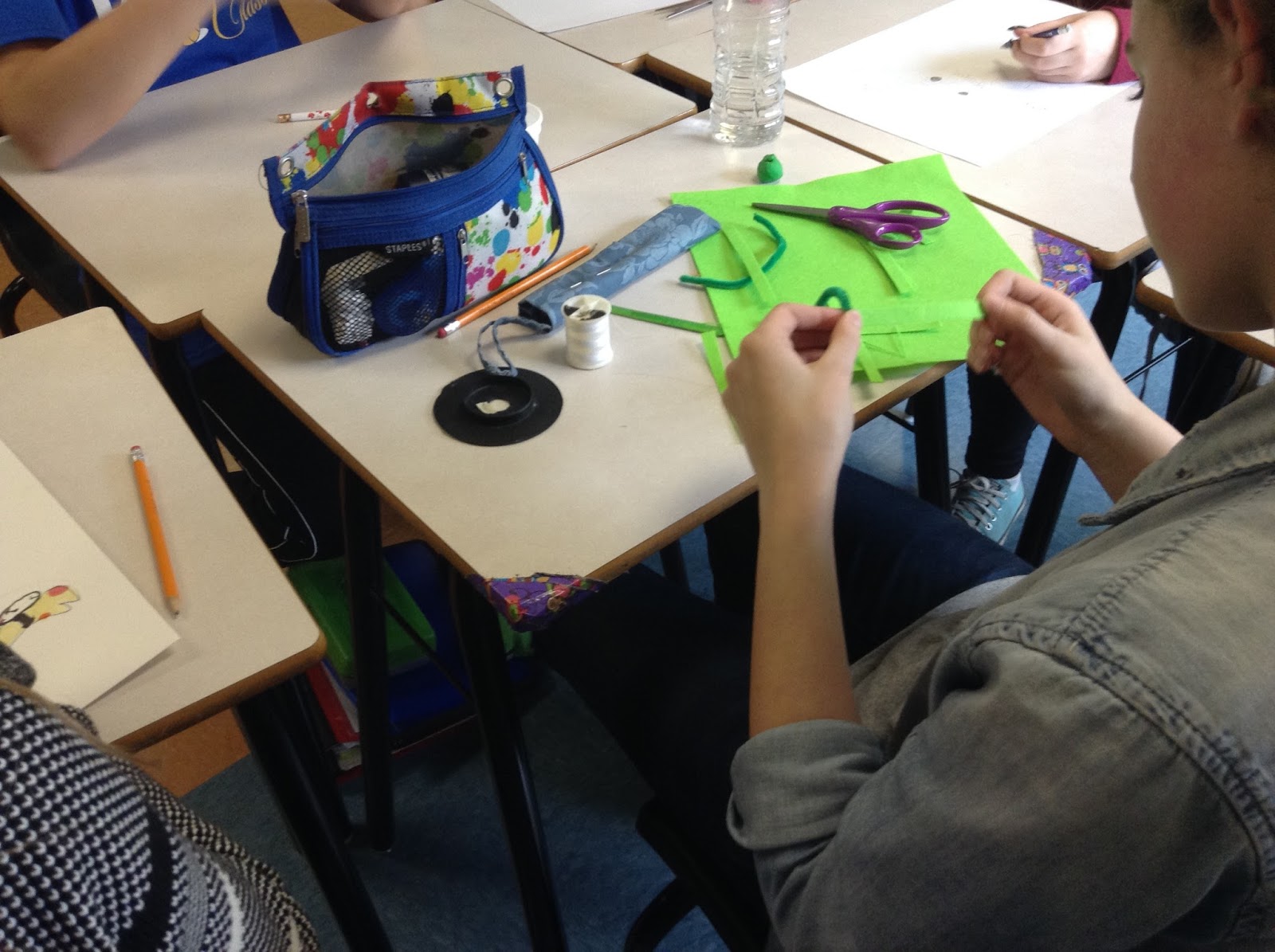
Appropriately, today is "Dr Seuss Day". My grade 7 English Language Arts class has been working on an author study based on Dr Seuss for the past few weeks. The final aspect of this unit is to create their own "Seussville" character, and to write about their character using Dr Seuss-style writing. This week, students were engaged in what I like to call Organized Chaos while they brought their characters to life.

It's not always easy to achieve Organized Chaos in a classroom. It takes a lot of discussion and negotiation to get students to the point where they can be working independently, on-task, taking risks, helping each other, making messes (and cleaning them up!) and just generally being creative without a whole lot of intervention on my part. We've been working towards this point since the beginning of the year, but with only 30 minutes per day it takes time to get students on board with my particular brand of Organized Chaos and have them be successful. For the past two Wednesdays, we have had 60 minutes of class time together, and we have unlocked this achievement - and I couldn't be happier! This particular group of students will be in my homeroom next year, which translates into roughly 3 hours with me per day. It makes me look forward to next year, knowing that they are already skillful "Mme Gaudet Interpreters" ;-)

Here are some of their Seussville characters in progress. You'll notice that they are using a wide variety of supplies to achieve their desired goal. Lots of problem solving is going on in my classroom these days...