Showing posts sorted by relevance for query passion. Sort by date Show all posts

Friday, March 24, 2017

Passion Projects 2017 - Reflection #1

This year, I have decided to introduce my grade 8 students to Passion Projects. I have been wanting to do this for a while, but I wasn't sure I was "ready". And then I realized that doing Passion Projects could be my own learning experience. It doesn't need to be perfect, or ready, or complete. I just have to dive in and get started. This is terrifying, but necessary!

Over the past month, I have spent time putting together a website for my students, reading blogs by other teachers, and gearing up to begin this endeavour. I chose to get going just after March Break, so that there would be a clear starting point.

One of the things that is most important to me in doing Passion Projects with my students is to really give them an opportunity to explore what they are passionate about. So often, students are told exactly what to do, exactly how to do it, and exactly what they should take away from the experience. In preparing students for the future, I think it is so important for them to learn to navigate new experiences, tap into their interests, and deal with obstacles on their own (with support as they deem necessary)

The idea of "failing" is so engrained in our students these days that, many times, they are afraid to even try. I hope that this project will allow them to see that they can try something, modify it, retry, re-modify and eventually get something out of the experience. I also hope that students will come away from this project feeling that their passions and interests are just as valid (if not more so) than what is taught in a traditional classroom.

So far, my students have been working on choosing the topic for their Passion Project. Some of them had ideas right away, while others are having a difficult time thinking of something they want to explore. I think that students are so often told what to do, they aren't sure if their ideas are valid. I'm hopeful that they will come to class next Friday (our official "Passion Project Work Period" each week) with an idea that they are passionate about. I want to avoid choosing ideas for my students, or steering them too much - this should be an opportunity for them to open themselves up to new learning experiences.

Along the way, I plan to complete a Passion Project with my students. I don't want to ask them to take on anything that I don't value myself. I have decided to learn Spanish as my primary Passion Project this year. I will also be blogging about the experience of integrating Passion Projects into my classroom, and updating/creating materials as I go - I'm calling this my "mini" Passion Project.

I have obtained a lot of resources from various sources, and plan to share what I create as well.
Notable sources include :

If you are/have been integrating this kind of learning experience into your teaching, I'd love to connect with you! Drop me a comment below!

Friday, May 5, 2017

Passion Projects 2017 - Reflection #3


We are now on week 6 of Passion Projects in my class, and I wanted to take this opportunity to write about the experience of students who are have some struggles with the freedom this project affords them.

Our routine is to work on Passion Projects each Friday (if there is no school on a Friday, we work on Thursday instead) This regularity of scheduling allows students to plan for what they need to bring into school, work on things at home over the course of the week and report in their journals on Fridays, and predict when they will need to have tasks accomplished.

On Thursdays, I ask students to fill out a brief check-in page in order to let me know how things have been progressing with their projects, and to remind them that they need to bring all required materials the next day. As part of that check-in page, I ask students to mark on a line how they are feeling about their project - the responses can range from "Awesome" to "Meh" to "HELP!"

Weekly Check-In Page


This check-in page has been a great help in identifying students that are treading water rather than making significant progress. I go through them and schedule conferences with any students who are hovering in the "Meh" range (or who have indicated that they need HELP! - although nobody has felt that desperate yet...)

The "no unfortunately" was a red flag for sure!


This student changed ideas after the first week, and hasn't
seemed all that passionate about his new idea


This student turned things around without much prompting from me


At this point in the project, some students are recognizing that they have chosen tasks that they are not feeling passionate about any more. What seemed like a good idea at the time (using a new crocheting set, for example) has lost some of its lustre. The check-in page gives me a heads-up that someone needs to have a quick conversation and might need a nudge to get going in a different direction if they have lost their passion for their initial idea.

Out of 25 students, only 2 have found themselves in this situation so far (the third person was just feeling a bit overwhelmed and was able to get back on track with little difficulty). The vast majority of my students are engaged and excited on Passion Project work days, and work independently for the entire hour. The two exceptions are students who might have needed to reflect a little more on what really makes them excited before settling on their project idea.

I am still learning Spanish as my Passion Project alongside my students. If you want to take a peek, here are the links :

Week 1 - Why I Want to Learn Spanish
Week 2 - Progress So Far
Week 3 - Plateau

Feel free to leave a comment below if you have any questions (or if you are also doing Passion Projects with a group of students!)

Friday, April 27, 2018

Passion Projects 2018 - Year Two is Underway!


Last year, I introduced Passion Projects to my grade 8 students, and it was a huge success overall. Students were engaged in learning something they found personally motivating, organizing their time, reflecting on their progress, and problem solving throughout the whole process.

This year, I am excited to relaunch this project with a new group of students. We are on week 4, and there are some projects that I am really excited to follow. While there are some very strong plans in place, several students are definitely just "going through the motions" rather than really investing their time in something that they find personally rewarding. I am struggling with how to help them realize that their individual interests are valid and deserving of attention.

It's so sad to me that there are students who can't even identify something that makes them feel passionately - or if they have an idea, it is sad that they don't believe that it will be an acceptable one for this project. What is happening that students don't believe their interests and passions are valid? And how can we as teachers address this issue? It's not enough to give them artificial choices within the classroom, we have to help them to invest in learning in ways that will be sustainable outside of the school environment.

Every week, the day before we work on Passion Projects at school, students fill out a check-in page so that I have a sense of who will need support to move forward. Yesterday, four of these pages stood out to me.

This student got a "yellow light" last week because their peers did not think they had a solid enough plan. I'm glad to hear that he feels back on track this week! 

This student arrived this morning and told me they were unhappy with their previous choice of project (learning to play bass guitar) because it had become more of a chore rather than something they really enjoyed. They came prepared with a new plan, and seem very excited!

This student, in contrast to the one above, is stuck on choosing a new project. They have not come up with a new idea on their own, and they are one of the students I was referring to earlier who seems unable to articulate something they are passionate about.

This student received a "yellow light" from their peers last week and has really turned it around. They have come with an idea and a new sense of purpose after a conference with me last week.

I think I made a mistake this year during the roll-out of Passion Projects. Because I had already done a project last year, I had more materials to share with students than I did in Year 1. My project last year was to work at learning Spanish, and I shared that project with my students this year. I now have 4 students (out of 19) who are learning a language as their Passion Project. I'm not certain that it is because I presented them with my project from last year, but I am concerned that I may have inadvertently swayed them in a direction they might not otherwise have take. This is something that I need to consider for next year when I introduce the project again.


Random other thoughts :
We are currently undergoing a curriculum realignment for middle school that will be piloted next year in several schools in Nova Scotia. From what I'm hearing, one of the major components of the realignment is to integrate more project-based learning. Depending on the supports that are put in place, I think this could be a good direction for middle school education, and this model lines up well with what I have been doing in my classroom for years.


Saturday, April 8, 2017

Passion Projects 2017 - Reflection #2

This week's major assignment in the world of Passion Projects was creating a 60-Second Pitch. Students presented their pitches to the class, and their peers had an opportunity to ask them questions and to assess whether or not they think that each individual is on the right track to begin their Passion Project.

In order for a student to get the "green light" for their project, at least 75% of the class has to give them their approval. I used ZipGrade and bubble sheets that were numbered 1-25 (each student was assigned a number in alphabetical order) At the end of each 60-second pitch, students either coloured in the Yes bubble or the No bubble for the corresponding number, depending on whether or not they thought the project was thought through enough. This app made it very easy to determine how many people had voted to approve each project - doing it all by hand would have been painful!

I chose to "yellow light" student #2 as I also had
some questions about his project. A short conference later
and his idea was clearer and ready for the green light.


This worked really well, and most students were given the green light by their peers. A couple of students got the yellow light (between 50% and 75% of peers voted to approve their project), and nobody received a red light (which would have been less than half of the class voting to approve) I was worried that students would simply green-light everyone, but that turned out not to be the case. I was able to have short conferences with those students who received the yellow light, and helped them to clarify their ideas a little more.

So far, I have seen huge amounts of motivation during this project. Students are conducting independent research, helping each other by asking good questions, arranging conferences with me as needed, spending time on the project outside of school time... All in all, a very successful start.

I do anticipate that some students will eventually hit a wall in their project, and I am hopeful that it will be a learning opportunity for them. If they can learn how to deal with failure, how to persevere, how to be flexible in thinking and planning then I will consider the project to be a success overall.

I am doing a Passion Project alongside my students. You can find my Learning Spanish blog below :

Week 1 - Why I Want to Learn Spanish
Week 2 - Progress So Far
Week 3 - Plateau


Wednesday, April 17, 2019

Students and Passions and Blogs, Oh My!

Bitmoji ImageThis week marks the beginning of Passion Projects 2019! I introduced the concept yesterday to huge enthusiasm from my grade 8s, several of whom have older siblings and who have been waiting for this project to begin with great anticipation.


This year, I am trying something different. A common refrain, as readers of this blog - and my students - know by now! I have asked all students to set up a blog and to share the link right away. In the past, I have had students create blogs (or paper journals) but only share them at the end of the eight weeks. This time, I want students to be able to view each others' blogs throughout the project, in the hopes that having an authentic audience will encourage them to take more initiative in documenting their progress.

All students have created their basic blog, and some have written fairly extensive first entries! I am super excited to see where this goes. There were a few students absent today, so I will update this list once they have had a chance to create their blog. Happy reading!

Tanisha - Makeup
Alex - Flamethrower
Ryland - Potato Launcher
Cole - Lego
Makayla - Getting in Shape
Emily - Learning songs on the Guitar
Emma - Nature Photography
Aidan - Free Throws
Maddy - Learning to play Violin
Monica - Cooking
Kalan - Building a little house
Skye - Learning Italian
Carmen - Composing music
Milo - Learning Norwegian
Adrianna - Protecting Sea Turtles
Julian - Cardboard Projectiles
Nash - Creating a Painting
Luc - Smoke Bomb
Adam - Creating a Rap/Hip-Hop Song
Amelia - Learning German 
Stuart - Food Delivery Robot

Ryan - Homemade Go-Kart 


At the end of working on this today, students did not want to leave for lunch. One approached me and said, "I just want you to know that this project is revolutionary. Not just for me, but everyone in the class is so excited about this." Music to my ears!

Bitmoji Image

For more information on how I do my Passion Projects, you can see the website I created for students or my blog post from 2017

Sunday, August 5, 2018

#YouMatter

I've been thinking a lot this summer about how much of teaching is relationship building. Knowing our students, understanding them as people, as learners, as individuals is so important. If they don't feel that we are interested in them, that we respect them, why would they believe they have anything to learn from us?

I'm working on some plans for classroom design, flexible seating, more inquiry based learning, passion projects... and what it keeps coming down to for me is having a relationship with my students that is built on trust and care.

Inspired by a tweet from Todd Nesloney (@TechNinjaTodd), I wrote my students a back to school letter that I will print and send to their homes the week before school starts. Although I taught most of the students who will be in my grade 8 class last year, we spent a very limited amount of time together. And after almost three months apart, I want to make sure they hear the message from me that they are important people, and that who they are matters.

Here is a copy of my letter, please feel free to copy/adapt any part of it if you plan on doing a similar thing. I used Bitmoji to create the image at the bottom (it looks more or less like me!), and the Magic Rainbow Unicorns add on for Google Docs to create the rainbow effect of the text.


Monday, March 25, 2019

It's the Little Things

Sometimes, it's the smallest things that stand out. I had to be out of my classroom today to fill in for the principal. This was a sudden occurence, for a sad reason, and it is the day after March Break. My plan was to spend the day reconnecting with my students, checking in, getting excited for the final stretch of this school year.  

When I am going to be out of my classroom, especially if it is unexpected, I always email my students with a plan of what the day will entail. I teach my homeroom for upwards of 3 hours per day, in a variety of different subject areas, so prepping for a substitute can be a daunting process. Emailing the students puts some of the onus on them to get things accomplished even when I'm not in the room. It cuts way down on, "But the substitute didn't tell us what we were supposed to do!" 

Although my students are growing up as "digital natives", they are not very diligent at checking their emails. I often will include a little challenge at the end, so that those who do read all the way through have a fun response to send to me (and a reward in Classcraft for such a response never goes amiss!) Last night, as I will not likely have time to check in with each of them today, my challenge was for them to send me a picture expressing how they feel about coming back to school after March Break. The two that I chose to include reflect the excitement I feel about our upcoming Passion Projects, our end of year Interdisciplinary Unit, and my normal excitement at reconnecting with my students after a break.

Bitmoji ImageBitmoji Image


Here are the pictures I received from five students in response:


Image result for noone is as excited as me


It's the little things that make a difference. Emailing to let my students know I will be out of the classroom is a tiny, easy thing - I copy and paste notes from the plans I make for my substitute. Letting them know I am excited to see them again costs me nothing, and the responses I get tell me so much (I'll be checking in with the student who sent "ok" and no picture to make sure things are really OK with them). Even though I'm not in my classroom today, I feel like I reconnected in a small way.

Saturday, December 12, 2015

Recreating a Painting in Minecraft

I've been dabbling with Minecraft for the better part of a year (or, more accurately, with MinecraftEDU, the educational mod that is available thanks to the wonderful people at TeacherGaming) Through our Exploratory program, I've experimented with a wide range of worlds, mainly with students who have prior experience with, and lots of passion for, Minecraft. My main goal, however, has always been to integrate Minecraft into my teaching practice.

This week, for the first time, I had an opportunity to do just that, in the context of grade 8 Visual Arts. The other teachers who teach Visual Arts with me were incredibly open-minded, and let me take the reins (and I think they were as pleased with the results as I was!)

I created a questionnaire for students, asking them to choose a painting that they would recreate in Minecraft, with a group. Their choices were:

Starry Night - van Gogh
The Starry Night - Vincent van Gogh

Tahitian Landscape - Gauguin


Three Cats - Maud Lewis


The Scream - Munch


The Great Wave off Kanagawa - Hokusai


Composition #2 (1920) - Mondrian


Three Musicians - Picasso


Tulip Field with the Rijnsburg Windmill - Monet


After students had made their selections, I assigned them to work in groups of four or five. Surprisingly, only one or two students had chosen the Monet, and none were interested in the Picasso, so those two were not recreated.

Upon entering the Minecraft environment, students found themselves in a room with 8 doors, each labeled with the title of the painting as well as the students' names.


They walked through the door, and teleported to an empty field with these instructions:


And then they got to work. Sitting next to their group members, they decided what format their recreation would take, and then dividing tasks to be as efficient as possible in their building. Several students who generally let others take the lead really stepped into a leadership role at that point, as they have lots of experience in Minecraft. There were two students who had never played Minecraft before, and their group members were patient in explaining how to move around and place blocks.

Here are the results of two days of building (approximately 90 minutes in total) :

Starry Night (work in progress)
Look at all the detail they have included! The tiny houses! The swirls in the sky!

Tahitian Landscape (work in progress)
My newest Minecrafter created that mountain from scratch. I am also quite impressed with their choice to combine a 3D idea with a top down view.

Three Cats (complete)
This group took on the challenge of finding a way to make their cats look fuzzy :-) 

The Scream (complete)
All the detail! The bridge! The sky!

Great Wave off Kanagawa (complete)
These students struggled a bit with their idea and their ability to work as a cooperative group. They became frustrated and destroyed what they had begun two times. As a result, they didn't have a lot of time to create their painting, and it is significantly smaller than the others. However, their use of real flowing water, and the fact that they placed NPCs (non-player characters) in their boats and named them after themselves more than makes up for the size! And in the end, they were very happy with their effort.

Composition #2 (complete)
This one was the simplest, but I was impressed by the amount of thought and planning that went into getting the proportions correct! 

All in all, I consider this first educational application of Minecraft to be an enormous success. Students were engaged, creative, cooperative problem solvers.

On Tuesday, all students will go on a gallery walk through the paintings of other groups. I can't wait for them to appreciate the work that each group put into their recreation, and to show off their own piece of art!

Take a Video Tour!


Wednesday, February 13, 2019

Creative, Autonomous, Accountable

Image result for flipgrid

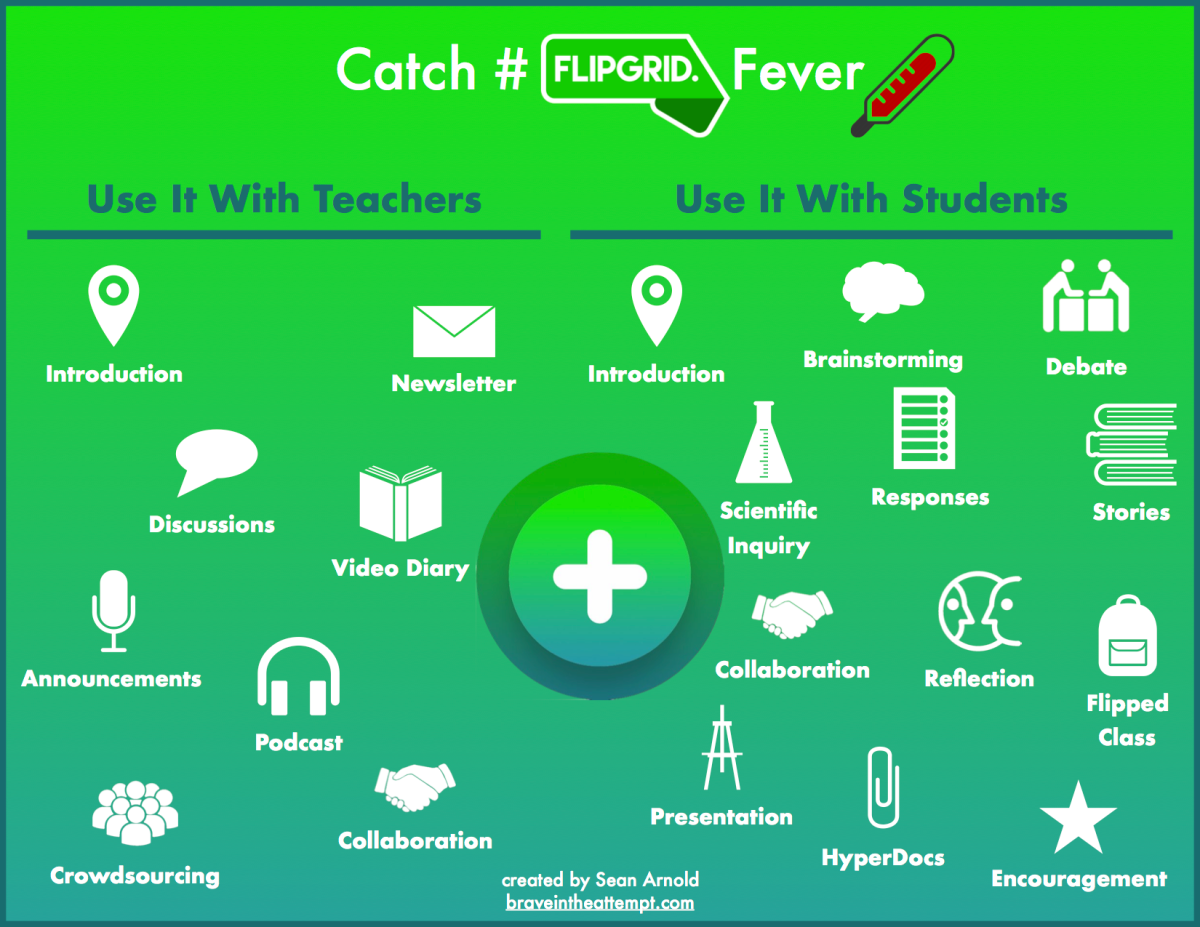
We have been using Flipgrid quite a lot this year - it's one of my favourite new finds. I dabbled a bit last year, but this year I've made a concerted effort to use it more consistently. I've made some progress in that area, and I'm looking forward to using it more effectively as time goes by.

This is the tool fo you if you have ever wanted a way for students to provide a verbal/video response to a prompt without needing to host the video somewhere (eg film on an iPad, then upload to Google Drive, then share... so many steps!) Students can log in with their school email credentials and record a video right away. The teacher has control over whether the videos are private or viewable by other students in the class (or, in fact, by other students with the link to the "grid")

There are lots of great resources created by teachers for integrating the use of Flipgrid in the classroom and beyond. For example :

Flipgrid eBook - The Educators' Guide to Flipgrid. This has everything you need to get started. How to sign up, how to give your students access, how to go beyond simple videos.

Flipgrid Integration - So many ideas for integrating Flipgrid in specific subject areas, for specific ages!


Following Global School Play Day (see last week's post), I asked my students to reflect on their experiences. I recorded a video prompt in Flipgrid, and provided them with some reflection questions to consider.


I was out sick, so this was an activity that I was able to leave for my students to complete with a substitute (another perk to using Flipgrid!). Many responses were thoughtful and detailed some (as is often the case in middle school when there is a substitute) lacked depth. When I do this again next year, I will take more time to prepare my students to respond thoroughly.

Most of the feedback I received was very positive. Students were happy to have had a "break from the normal school day." For the most part, students felt that the expectations had been followed by their peers, and that it was a fun experience. Many of them commented on the fact that it was enjoyable to be able to do what they wanted, when they wanted, speaking to the fact that a "normal" school day is generally structured by the teacher. I am interested in exploring how more of that freedom can be incorporated into my classroom.

One of the comments that was surprising to me came from a grade 8 student. She stated first that she enjoyed Global School Play Day, but that, "I wished there were more activities I could do, because I was kind of bored. Like, if I was allowed to, like, build a fort, I would be pretty happy."


I was surprised by this response because I tried very hard to be clear that I was not putting any limits on what students were "allowed" to do. In fact, I explicitly stated that, as long as they were following the expectations we established together, anything was possible. All of the students in my classroom chose to spend most of the day playing either cards or board games, so I wonder if she felt that building a fort would break some sort of unspoken rule. I will absolutely follow-up with this particular student, to determine how I could have made it clear that any activity was possible.


Students' Flipgrid responses

Another comment that came from multiple students, and one that didn't surprise me at all, was that they wished there had been more organization to the day. They are so used to having their time scheduled for them, they struggled when they were given freedom to choose their own paths. I see this in project work as well, and I hope that having experienced this day of unstructured play will allow them to draw some comparisons when it comes time to choose their passion projects, or other free-choice ways of showing their learning.

Thinking creatively, making decisions autonomously, and holding themselves accountable are skills I strongly encourage in my students. These are the skills they will need moving forward. These are skills we could all stand to improve upon.

Saturday, October 13, 2018

Voluntary Homework


This year, I've started a new weekly routine in my English Language Arts classes. I call it "Would You Rather Wednesday", and my students are very invested in it. It often comes up as something they're looking forward to in our morning circle on Wednesdays, and the conversation frequently extends past the end of our scheduled class time. It's quite a simple activity, but so far it has paid enormous dividends. 

I choose a "would you rather" statement, then we sit in a large circle and talk about it. It's that simple. So far this year we've discussed the merits of traveling in time to visit distant ancestors vs future descendants, having a pause or a rewind button on life, being bored contrasted with being too busy, and preferred position in sibling order (oldest or youngest). The last two have prompted the voluntary homework after which this post is titled.

During our conversation last week about boredom vs being over scheduled, one of my students said the magic words... "Well, research shows that being bored can actually increase your creativity." To which statement another student responded, "There's research that shows that there are benefits to being busy." Ding ding ding! Voluntary homework was born. I told both of them that they couldn't just throw statements about research around without following up with documentation to support their claims. Each of them was tasked with finding one article to support their argument. This was completely voluntary. There would be no effect on their grade in my class, and there would be no penalty for not completing the task. By 7pm that night, one of the students had already provided me with an excerpt and a link to a full article about the benefits of boredom. I shared it with the class the next day, and awarded the student 500 XP in our Classcraft game.

This week, our question seemed fairly mundane : "Would you rather be the oldest or the youngest sibling?" The conversation went as might be expected in a grade 8 classroom with some students expressing dissatisfaction with their place in the pecking order of their family and wishing for a change, while others were content to uphold the status quo as they felt the privilege of being oldest/youngest/middlest. And then, in an attempt to keep the conversation going, a student asked about being a twin. Or a triplet. Or a... dectuplet? A whole basketball team made up of identical "me"s! That's when the magic words were uttered. "Has a woman ever had ten babies at once?" "Voluntary homework!" I exclaimed. She reached into her pencil case, pulled out a Post-It note, and proceeded to write herself a reminder while everyone looked on. Six more hands flew into the air, and each question began with the words, "I'm pretty sure I'm going to get voluntary homework for asking this, but I really want to know..." In all, seven students were "assigned" voluntary research homework on a range of topics involving twins, birth weight, rates of conjoined births, births of boys vs girls. By evening, I had 5 emails with various documents attached, and I created a post on our Google Classroom to share the results of the voluntary homework done by those students who took the time to complete it. One of my students has even coined a phrase for this action : Searchez uup! (We are a French Immersion class, and we looooove franglais)

A few of the students who received voluntary homework haven't done it, but the percentage of those who are choosing to research something on their own time and then report back to the class is very gratifying. They are seeing a connection between the classroom and their interests, and taking ownership of their learning. I foresee some very strong Passion Projects later this year.

Next steps, I will do some explicit teaching on how to find scholarly articles to support claims, and how to effectively search using keywords. Creating a culture of excitement around research seems like a great way to encourage lifelong learning. Searchez uup, tout le monde!

Wednesday, May 15, 2019

A Funny Little Experiment


I've been working on an experiment for the past few months, and it came up in conversation with a colleague this morning so it must be time to write about it! The experiment is simple. I have mostly eliminated the words "but" & "however" from my vocabulary.

Now, this may sound bizarre to you. "But what about when you need to say something and then say the opposite?" you may be shouting at your screen. Well, I have replaced those words with "and", "also" & "additionally." How does this sound in practice in the classroom? Here's an example of how a conversation might go:

"Mme Gaudet, I'm thinking of making a flamethrower for my Passion Project, would I be allowed to do that?"

Option 1 : Yes, but you will have to get permission and be safe.
Option 2 : Yes, and we will discuss ways that you can be safe while you do that.

The "Yes, but" option sounds a lot like "No", while the "Yes, and" response doesn't close off any avenues.

I'm also consciously using "and" instead of "but" when giving instructions and feedback to students. "This project will be challenging, and I know that we can do it." Rather than setting up a dichotomy between what is challenging, and what we can do, I link the two ideas together and it becomes as if one follows naturally from the other.

I don't know if this shift in language is evident to my students, or if it is having an effect on their perceptions. I hope so. I hope that they hear in my words a sense of possibility, a sense of openness, a sense of "and".