Showing posts with label explicit teaching. Show all posts

Thursday, February 7, 2019

It Takes Time, and it is Incredibly Worth It

Today was Global School Play Day (globalschoolplayday.com) and my students and I participated wholeheartedly. There was a wonderful hum in the room all day, with all of my students engaging in unstructured play time. They organized themselves, chose their activities, rose to the expectations we had set out, and generally had an awesome day. The activities they chose were varied and completely self-directed.


Some students preferred to spend their time reading...
... or drawing ...


... or learning to play chess!


Some of the highlights from the day include:

- My newest student (arrived just three weeks ago) noticing someone not being included and inviting them to take part in a game without making a big deal out of it.

- The sincere and sudden vocal excitement from all players when another player took a risky move in Black Jack and it paid off. The rest of the activity in the classroom stopped and we all revelled in the glory of a well-timed risk.
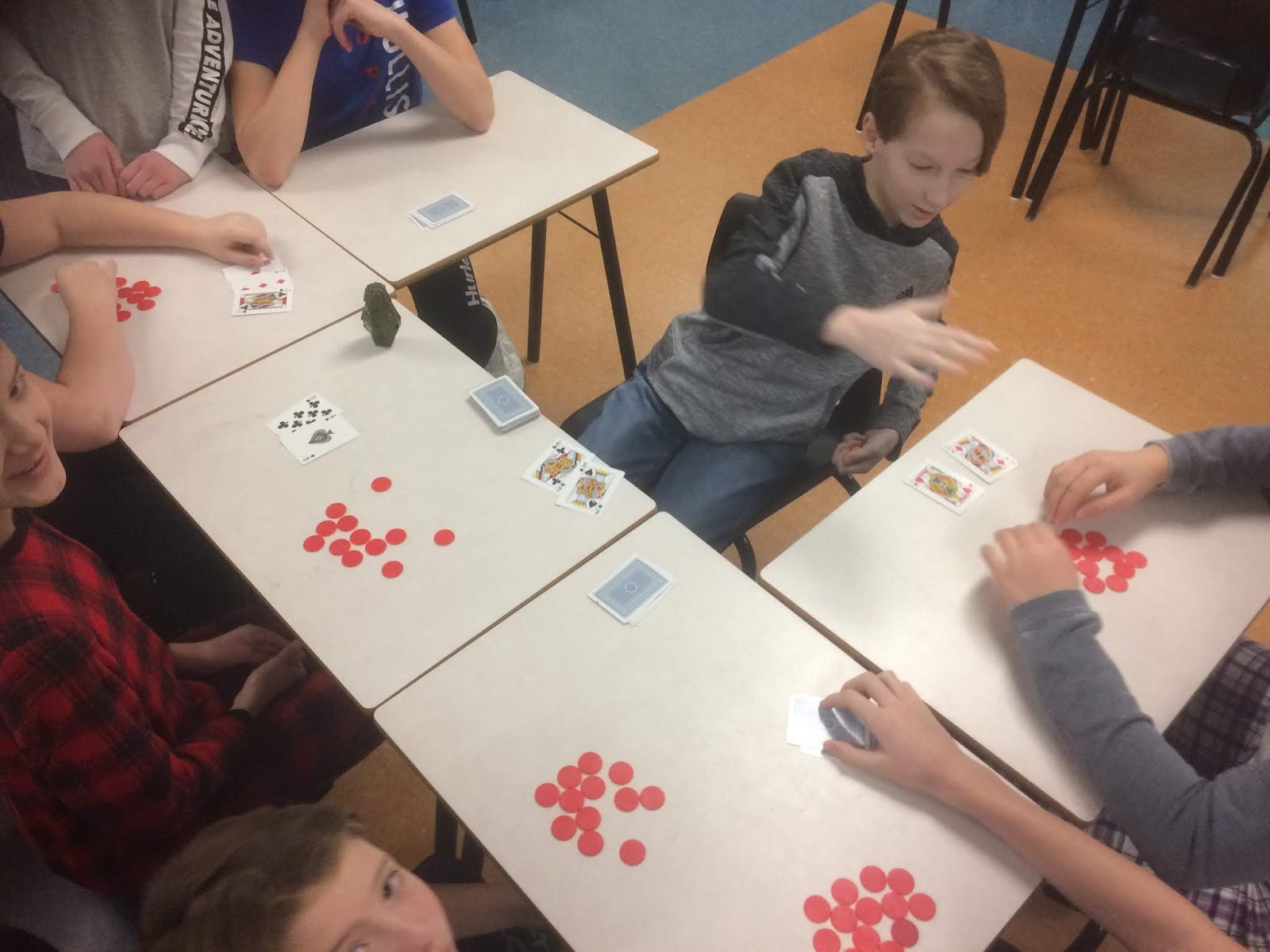

- This exchange, fully embracing the expectation to be good communicators :
     "Do you feel like playing Spot It with me?"
     "Not right now, but when I'm done this game of Solitaire I will."
     "OK, sounds good."


- This statement when I approached a group playing Cranium, showing their willingness to improvise. "We don't really know what the actual rules are, so we made up our own. Is that OK?" YES.


One of the most important contributors to the success of GSPD was the lead-up over the two days preceding the actual event. As a class, we spend a significant amount of time focused on building strong community, so I already have some structures in place to set expectations collaboratively with my students. For this activity, I began by outlining my expectations of them for the day.

Students then took some time to come with expectations they had of me and of each other. Each class came up with their own, and the differences in their expectations is reflective of the culture of the individual classes. The grade 8s spend a lot of time with me (at least 3 hours daily), while the grade 7 class only comes to me for an hour each day. As a result, we haven't had as much time to focus on community building.

Grade 8 Expectations


Grade 7 Expectations


We also talked about what they were excited about for a day devoted to unstructured play, and what they were worried or concerned about. This part of the conversation was very helpful to me, as it let me put some of their worries to rest (some worried about what would happen if a toy was accidentally broken, some that they would not be able to handle a full day without an adult organizing them into activities and groups, others that there might be judgement about what games or activities people chose) I was so impressed with their openness in sharing their worries, and the care they took in responded to the concerns of others (some of the expectations above came out of the conversation about worries) Without those conversations ahead of time, I think our day could have played out very differently. Having a list of expectations that we co-created allowed me to quickly make reference to #4 for example, and students would use them to remind each other of what they should be doing.

This student taught multiple classmates how to play chess over the course of the day

Students creating a marble maze together


I had a moment of concern when I sent out my memo to parents last week, explaining the event. We have had some school closures lately because of weather, and this would be another day without "real school", but I did not receive any negative responses from parents at all. I've been really focused on building community with my parents this year as well, through very regular communication about what goes on in our classroom. I hope and believe this has contributed to a certain level of trust when it comes to some of the paths I take with my students.

Grade 7s at play!


Building a strong community is the reason I can engage in the types of activities I write about on this blog. It takes time, and it is incredibly worth it.


Wednesday, November 28, 2018

Not All of Them, Not All of the Time, but Enough

In 2011, Xara Choral Theatre was approached by the Truth and Reconciliation Commission to create a piece of choral theatre for the Halifax event. I was fortunate to be part of Xara Choral Theatre's commissioned adaptation of the book Fatty Legs. The book tells the story of one Inuit girl's experiences at Residential School in Aklavik. For that first performance in front of 500 survivors, we were honoured to have Olemaun, the Inuit girl of the book, and her daughter-in-law Christy join us as our narrators.

I felt great shame and anger in 2011. It was the first I had ever heard of the Indian Residential Schools in Canada, and I felt that my education system had failed me epically. At the time, I had already been a middle school teacher for 7 years, and the feeling that I had been failing to educate my students about the realities of Indigenous experiences in Canada was upsetting. Every year since then, I have made it a priority to read Fatty Legs with my students, and to spend time discussing the legacy of residential schools beyond that one story.

We have remounted our choral theatre production of Fatty Legs three times since 2011, once for a tour of schools in the Maritimes, and twice for school shows in Ontario. My students have been overwhelmingly supportive of the time I need to take away from my classroom in order to bring this story to other children.

This year, following my two weeks away on tour, we were fortunate enough to be able to organize a Google Hangout with Olemaun and Christy. My grade 8 students took time in advance to prepare questions, and to organize the classroom in a way that would look and feel welcoming over a video chat (we went through several iterations of this, using the projector to gauge how we would look to a viewer - they wanted to avoid looking "intimidating, like we're ganging up on them.")


My students blew me away with their insightful questions, the intentness with which they listened, and their respect for Olemaun's lived experiences. They were kind, they prefaced their questions with some of the reasons why they were asking, they asked follow-up questions that showed they were really listening and reflecting during the conversation. Not all of them, not all of the time, but enough that the flow of the dialogue was natural and did not feel like an interrogation.


Forty-five minutes is barely enough time to scratch the surface of the legacy of residential schools, nor is it adequate for students who are speaking with an elder from a First Nations community (most of them for the first time). Afterwards, I asked students to reflect in writing on what had resonated the most with them in the conversation, and if they had any further questions that had come out of hearing the perspectives offered by Olemaun and Christy.

Below are some of the highlights. Some students chose not to respond to the writing prompt (this is always their right during our writing periods), but many did, and what they had to say revealed significant understanding and reflection.


Friday, May 15, 2015

Teachers, We Need to do Better

Teachers, we need to do better.

For the past ten days, I have been on tour with Xara Choral Theatre, bringing a show called Fatty Legs (based on the book by the same name) to schools and communities around the Maritime Provinces.

The show deals with the reality of the Residential School System in Canada, which is something that we are just starting to teach about in schools. For a long time, this practice of removing Aboriginal children from their homes, and placing them in schools with the aim of erasing their culture (“Kill the Indian to save the child” was the official wording), was not acknowledged – even given the fact that the last school of this type closed in 1996. I only learned about this part of Canadian history when we first did the show in 2011 for the Truth and Reconciliation Commission event in Halifax. Since then, I’ve made sure to teach at least my homeroom about it each year, by reading and discussing the book Fatty Legs.

I was thrilled that we were finally able to remount the show and tour it to schools. We performed for over 4000 students during our ten days of touring.
Performing in front of a rapt audience of students in grade 2 through 6


Most schools were very receptive, particularly at the elementary and middle school levels. We were prepared for students to have questions about the performance, and about the residential schools. We were prepared for people to express anger, sadness, confusion – and those reactions were present when we did our Q&A sessions after each show. Opening honest and constructive dialogue was one of the main goals of this show.

However, we had some very negative experiences in the last two days of touring. In two separate high schools, students exhibited a complete lack of respect for both the subject matter and the fact that 15 people were attempting to perform in front of them.

In one of the schools, students openly mocked the dancer by mimicking her movements. They were spoken to by a teacher after about 20 minutes of this behaviour. Other students were making jokes (either about the show, or about something else entirely) and laughing loudly. Several of them were eventually asked to leave by another teacher. I am grateful to those teachers who took action to stop the disrespectful behaviour, although I wish it hadn’t happened in the first place.

In the final school, a student THREW A ROCK onto the stage during the performance. As the saying goes, the show must go on. One of the singers took it upon herself to move the rock out of the way so that nobody would be injured (the show is performed in sock feet). To my knowledge, no action was taken by teachers in response. One minute before the show ended, the bell rang to signal the start of the next class. Approximately 40 students, scattered throughout the audience, stood up and left. When I asked them if they could stay for the last minute of the show, they told me they had to leave because they had a test. According to the students, their teachers (two different teachers, from what I understand) told them that if they arrived late for the test, because of “the play thing” (students' words), they shouldn’t bother coming at all and they would receive a grade of 0 on the test.

TEACHERS instructed students that they were to get up while a performance was in progress in order to be on time for a test.

Teachers devalued a show about a terrible part of Canadian history that has been shrouded in silence for over 100 years.

Teachers, we need to do better.

We need to explicitly teach our students about respectful behaviour during performances, and model that behaviour ourselves.

We need to intervene when students engage in disrespectful behaviours.

We need to take a step back and realize that the test students are writing in our course may not be the most important part of their day. Or, at the very least, we should not use threats to indicate to students that it is acceptable to behave disrespectfully.

Teachers, we need to do better.

We need to prepare our students before we take them to see a show that deals with serious subject matter. How (or if) we pre-teach our students sets them up for success. It also instills in them an understanding that there are behaviours that are appropriate in certain situations that are not acceptable in others.

I am so honoured to have been part of telling this story, of bringing this show to so many students. I burst with pride when I think about how our dancer, narrator, and singers persevered in the face of adversity to always give their all on stage.


But teachers, we need to do better.